WhatsApp follow-up messages for B2B sales: Meta's rules, timing and templates
WhatsApp is where many B2B conversations in Lebanon and the UAE actually happen. Here are Meta's rules for following up, when to send each message, and templates you can adapt.
Good WhatsApp follow-up messages in B2B sales are short, go out within a working day, ask one clear question, and reach only people who have agreed to receive messages from you. On the WhatsApp Business Platform you can reply freely for 24 hours after the customer's last message; after that, and to start any new conversation, Meta allows only approved message templates.
In Lebanon and across the Gulf, WhatsApp is not a side channel. It is where many prospects answer, negotiate and say yes, which makes follow-up discipline on WhatsApp as important as it is on email, and easier to get wrong.
What are Meta's rules for following up on WhatsApp?
Meta's WhatsApp Business Messaging Policy, last updated on 23 September 2026 when we checked it in November 2026, sets the rules. Some apply to every business account; others apply only to the WhatsApp Business Platform, the API that CRMs and shared inboxes connect to.
For everyone, on the WhatsApp Business app and the Platform alike:
- Opt-in first. You may contact people only if they have given you their number and agreed to receive messages from you.
- Honour opt-outs. A request to stop, made on WhatsApp or anywhere else, must be respected.
- No surprises. The policy tells businesses not to spam or surprise people; they should expect the messages they receive.
Meta's developer guide on getting opt-in adds that the opt-in must clearly name your business and make clear the person is agreeing to receive messages from it. It does not have to mention WhatsApp, and Meta leaves the method to you; its examples are a website form, an SMS, an automated phone menu and a signed paper form. If you ask on a sales call, say your company's name and what you will send, and record the yes.
The Platform adds a timing rule. The 24-hour customer service window opens, and resets, with each message the customer sends:
| Situation | WhatsApp Business app | WhatsApp Business Platform |
|---|---|---|
| First message to a new contact | Only with their opt-in | An approved template, with their opt-in |
| Within 24 hours of their last message | Any message | Any message |
| More than 24 hours after their last message | Any message, with their opt-in | An approved template only |
| After they ask you to stop | Nothing | Nothing |
When should you follow up?
Speed matters most at the start. A prospect who asks for a price on WhatsApp expects an answer the same day; if you need time for a proper quote, say so and give a time: "I'll send the full quote by 4pm." A short holding message keeps the thread alive, and on the Platform it can be free text, because the customer wrote last.
After that, a simple rhythm works for most B2B deals:
- Same day: answer the question, or say when you will.
- One or two working days after a quote: ask whether it reached everyone who needs to see it.
- About a week later: offer something useful, such as an answer to the objection you heard, and ask one question.
- Two weeks in, with no reply: send a polite closing message.
Count working days in the customer's country. In Lebanon, the week runs Monday to Friday, and many offices also open on Saturday mornings. In the UAE, the federal government has worked Monday to Friday since 1 January 2022, with Friday ending at noon, while Sharjah's government works Monday to Thursday, according to the UAE government portal. Private companies set their own hours, so note each customer's.
Mind the clock as well. Dubai is two hours ahead of Beirut in winter, and one hour ahead from late March to late October, when Lebanon is on summer time. A follow-up sent from Beirut at 4pm in November lands at 6pm in Dubai.
What should a follow-up message say?
Three rules cover most of it:
- One message, one question. Long messages with three questions get one answer, usually to the easiest. End every follow-up with a single question that is easy to answer: "Would Tuesday or Thursday suit you for a short call?"
- Refer to what was agreed. "As promised" and "following our call on Monday" remind the customer that this is a conversation, not a broadcast.
- Match the customer's language. In Lebanon, many conversations mix Arabic, French and English, sometimes in one sentence, and some buyers write in Arabizi. Follow their lead: a reply in formal English to a message in Arabizi can feel cold. In the UAE, most business buyers write in English; switch to Arabic when they do.
Many Lebanese buyers also send voice notes. If a customer sends one, a short voice note back is fine, but put prices, dates and quantities in writing, so nobody has to replay a recording to find them.
WhatsApp follow-up templates you can copy
Change the details in brackets; keep the shape. After a first call, once they have agreed to WhatsApp:
Hi [name], it's [your name] from [company]. Thanks for your time today. As agreed, here is our [price list]. Would [Tuesday] or [Thursday] suit you for a short follow-up call?After sending a quote:
Hi [name], did the quote for [the two branches] reach everyone who needs to see it? Happy to walk your team through it this week if that helps.When the thread has gone quiet:
Hi [name], one more thought on your question about [delivery times]: we can [specific answer]. Shall I update the quote on that basis?The closing message:
Hi [name], I won't keep chasing. If the timing changes, just reply here and I'll pick it up straight away. Thanks again for considering [company].On the Platform, a follow-up more than 24 hours after the customer's last message must be an approved template. Templates use numbered placeholders, so the quote follow-up becomes:
Hello {{1}}, this is {{2}} from {{3}}. Did the quote we sent on {{4}} reach everyone who needs to see it? Reply here and I can walk your team through it.Meta reviews each template, and a template must be approved before you can send it, so prepare your follow-up templates before you need them.
How many follow-ups before you stop?
If a prospect has not replied to three follow-ups spread over two weeks, send the closing message and move on. Leaving the door open protects the relationship without cluttering your pipeline, and in markets where people know each other, how you stop matters as much as how you start.
If anyone replies "stop", or asks you not to message them, stop at once and record it, so nobody else on your team messages them again.
The best follow-up is specific, short and easy to answer.
How do you keep follow-ups off one person's phone?
The biggest risk with WhatsApp is that commitments live on one salesperson's phone. When that person is on leave, or leaves, the deal goes with them. Record every agreed next step where the team can see it (the deal, the date and what was promised), and check those dates at your weekly pipeline review.
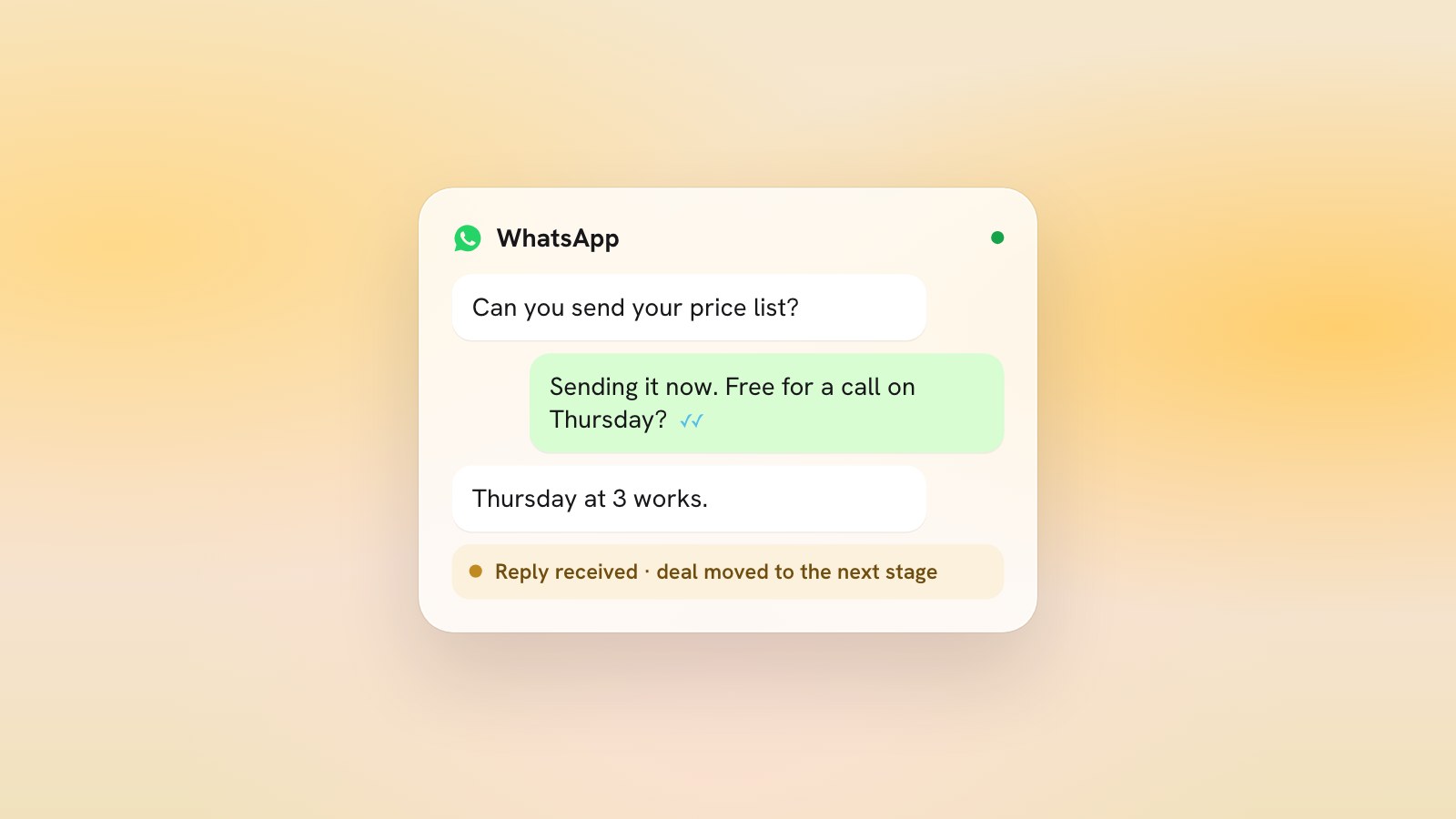
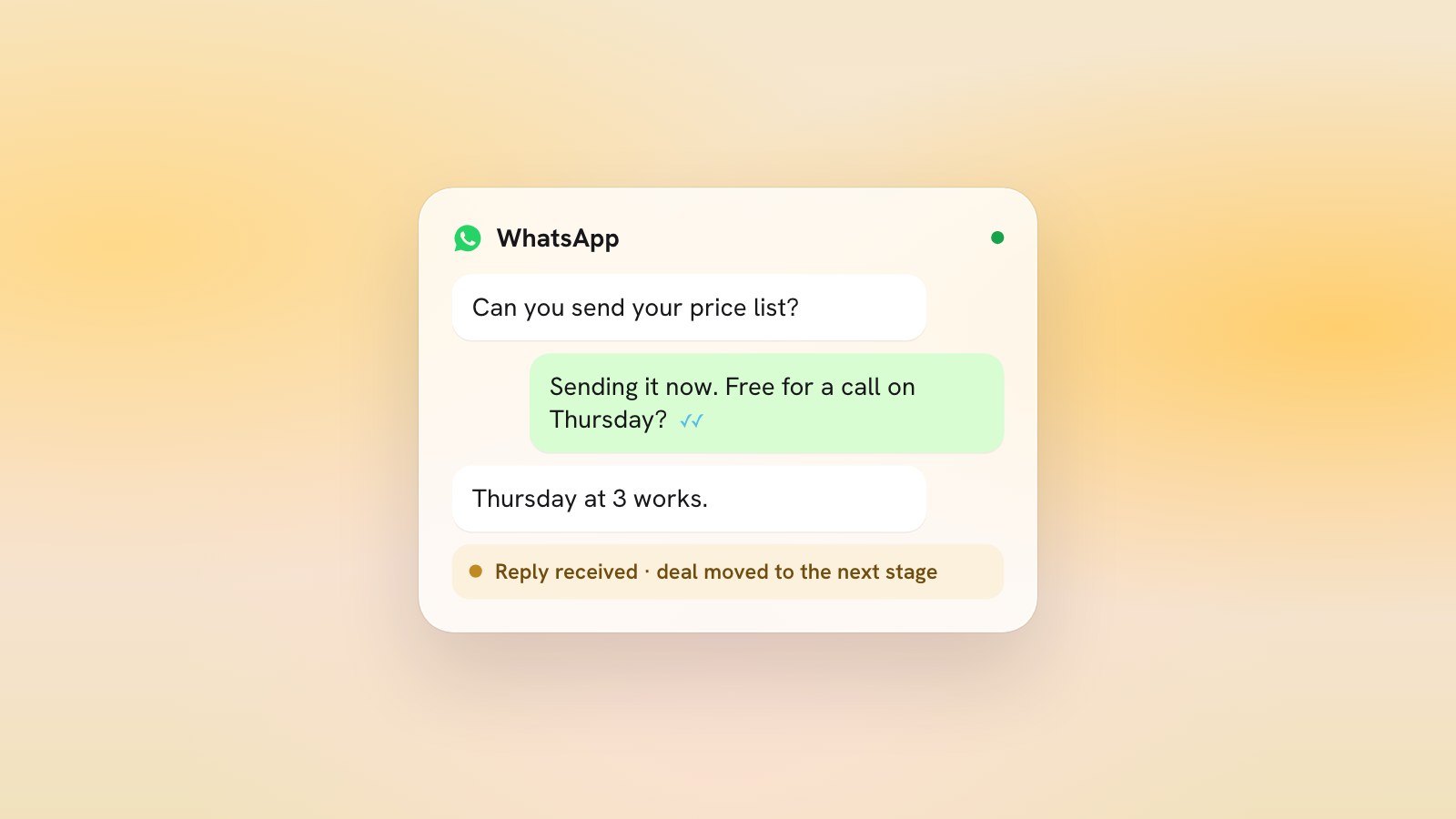
That is what a WhatsApp CRM is for. In LeadsMind, the inbox runs on your workspace's own WhatsApp Business number: an approved template opens the conversation, replies land in the deal's thread, consent is recorded on the contact, STOP opts the contact out, and a reply can move the deal to its next stage automatically. To let prospects message you first, which also opens the 24-hour window, put a click-to-chat link in your email signature or your proposals; the WhatsApp link generator makes one.
FAQ
Can I send a WhatsApp follow-up after 24 hours?
On the WhatsApp Business app, yes, to someone who has opted in. On the WhatsApp Business Platform, only as an approved template, until the customer writes again and reopens the 24-hour window.
Do I need permission to message a business contact on WhatsApp?
Yes. Meta's policy requires that the person has given you their number and agreed to receive your messages. A business card gives you a number, not a yes, so ask before you move the conversation to WhatsApp.
How long should I wait before following up on a quote?
One or two working days in the customer's country. Reply sooner if they asked for the quote urgently, and try not to leave a question unanswered overnight.
How many times should I follow up on WhatsApp?
Three follow-ups over about two weeks, then a polite closing message. Stop at once if they ask you to.
To see which companies to follow up with first, and the WhatsApp message LeadsMind would draft for the top one, type your website at leadsmind.ai/start.