Ideal customer profile (ICP): how to define yours for B2B sales in Lebanon and the UAE
An ideal customer profile tells your team which companies to chase and which to leave alone. Here is how to write one in an afternoon, adapt it for Lebanon and the UAE, and turn it into a score.
An ideal customer profile (ICP) is a short written description of the companies most likely to buy from you, pay on time and stay: their industry, size, location, the person who signs and the signals that show they are reachable. You define one by studying your best existing customers, writing down what rules a company out, and turning both into a score your whole team applies the same way.
Most sales teams do not have a lead problem. They have a focus problem: plenty of names, and no shared view of which ones deserve a call this week. An ICP fixes that before anyone opens a spreadsheet, and it is the first thing to write when you move into a new market, such as a Beirut firm starting to sell in Dubai.
What goes into an ideal customer profile?
Keep it to what you can actually find out about a company before you contact it. A profile built on data you cannot see is a wish, not a filter. Use this as a template:
| Attribute | The question it answers | Example: a hypothetical Beirut agency |
|---|---|---|
| Industry and sub-industry | What do they do? | Restaurants, specifically groups with several branches |
| Size | Can they afford you? | Three or more branches |
| Location | Can you serve them well? | Beirut and Mount Lebanon, with a separate profile for Dubai |
| Who signs | Whom do you need to reach? | Owner, general manager or marketing manager |
| Signals | Can you reach them, and is now a good time? | A mobile on the listing, a website, a branch opened recently |
| Exclusions | Who is never a fit? | Single outlets; franchises run from abroad |
Two notes on the Lebanese market. Headcount is rarely published for small and mid-sized Lebanese companies, so choose a size measure you can see, such as branches, or the number of people you can find who work there. And "who signs" often means the owner: in many family-run businesses nothing is bought without them, whatever the title of the person you speak to first.
How do you find the pattern in your best customers?
Look at the clients who pay on time, renew without a fight and send you referrals, and ask the same five questions of each:
- What do they do, exactly? "Hospitality" is too broad; "restaurant groups with more than one branch" is useful.
- How big were they when they first bought from you?
- Where are they, and where do their own customers come from?
- Who signed, and who else had a say?
- Why did they buy then, and not a year earlier?
Write the answers side by side. The attributes that repeat are your profile; the ones that never repeat do not belong in it. If you have only a handful of customers, include the deals you nearly won. The pattern matters more than the sample size, and a first version written from five customers is far more useful than none.
Be honest about the customers you would rather not repeat. A client who took a year to pay, or who needed twice the work for half the price, belongs in the analysis too, because what they have in common is the start of your exclusion list.
What should rule a company out?
A good profile says no as clearly as it says yes. Exclusions save more time than any other part of the profile, because every company they remove is a call nobody has to make. Typical ones:
- companies too small to afford you, or too large to buy from a firm your size
- sectors you cannot serve well, or where you have no reference customer yet
- buyers who only ever choose on price
- companies with no way to reach a decision-maker: no phone, no website and no named person
Treat exclusions as hard rules, not as points. If a company fails one, it comes off the list, whatever else it matches. Otherwise a company that is perfect in every respect except the one that makes it impossible to serve will keep rising to the top.
Should Lebanon and the UAE share one profile?
Usually not. The same offer often needs two profiles, because the buyers, the paperwork and the way of doing business differ.
In Lebanon, selling is relationship-led and WhatsApp is the everyday business channel. Conversations mix Arabic, French and English, and many offices also open on Saturday mornings. Add how the customer pays: since the banking crisis, many Lebanese companies pay in fresh dollars, by transfer or in cash, or through Whish or OMT, and a customer who cannot pay the way you invoice is not a fit, however good the rest looks.
In the UAE, most business buyers work in English, with Arabic welcome, and the emirate matters: Dubai, Abu Dhabi and Sharjah each have their own authorities and business communities. One attribute matters more than it does in Lebanon: whether a company is licensed on the mainland or in a free zone. The UAE government's portal says free zone companies can trade freely within their zone and internationally, but generally need a licensed mainland distributor, or mainland licences, to sell into the local market (checked November 2026). If your offer depends on the customer selling to UAE companies or consumers, that line belongs in your profile. More on selling into the UAE.
How do you turn the profile into a score?
Once the attributes are written down, score every company against them the same way. A simple version works in a spreadsheet: exclusions remove a company outright, must-haves earn most of the points, and nice-to-haves break ties. Two people looking at the same company then reach the same number, and the strongest leads rise to the top on their own. Lead scoring explained shows what to do with hot, warm and cold leads.
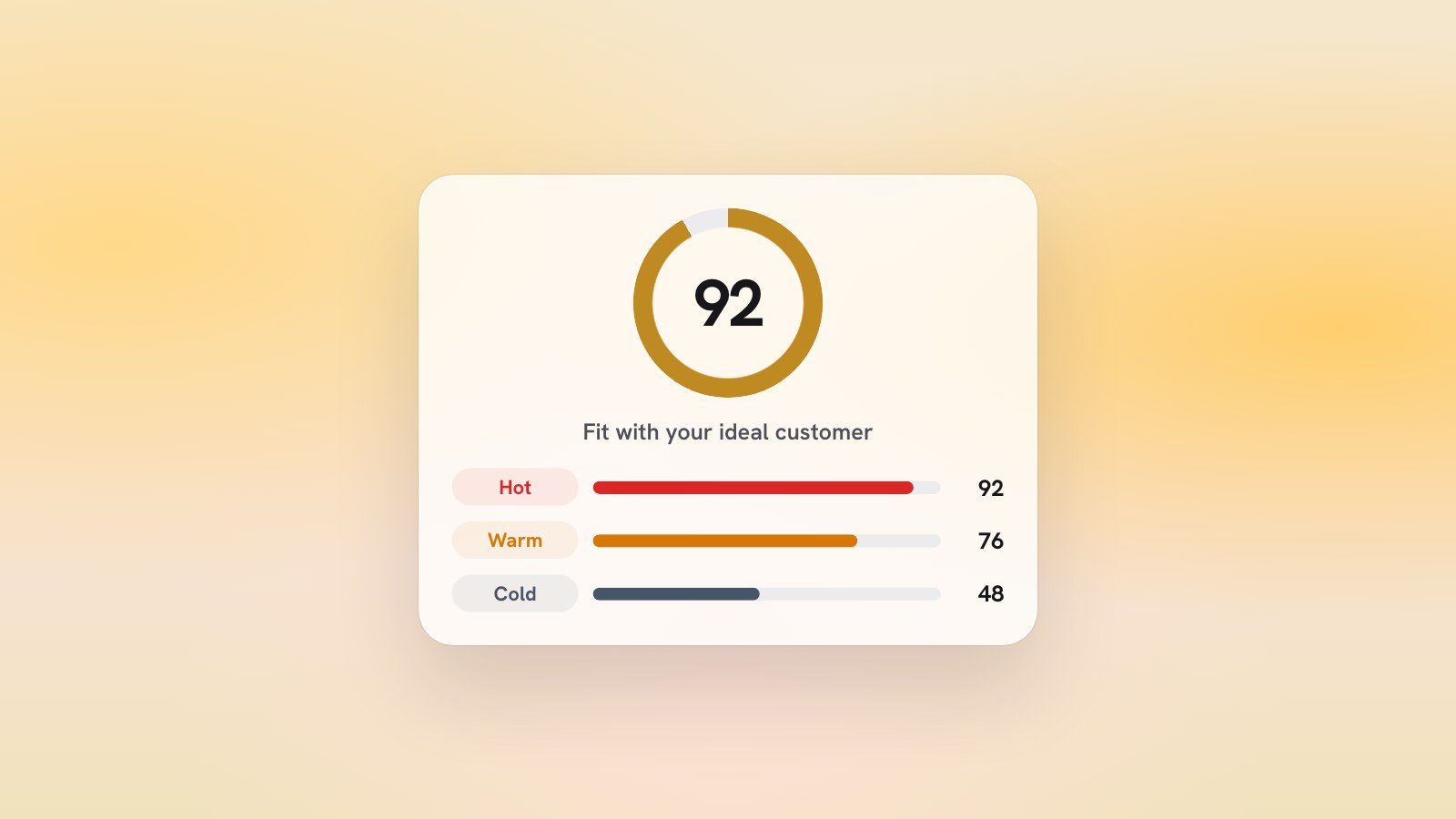
Software does the same at scale. In LeadsMind, you describe the ideal customer once (industries, sub-industries, cities, titles and seniorities) or let it draft the profile from your website. An AI model then judges every company's fit from 0 to 100, rule checks such as exclusions and required technologies rule companies out, and anything below the minimum score you set is marked as low fit. See how ICP scoring works.
How often should you review it?
Markets move, and a profile written a year ago may describe customers you no longer want. Put a short review in the calendar every quarter:
- Compare recent wins with the profile. Did they fit it, or did you win outside it?
- Read the reasons you lost deals. Do they point to a missing exclusion?
- Change the attributes, not just the wording, and tell the team what changed.
A profile that never changes is a profile nobody is using.
Then use the new version to build a prospect list by sector and city.
FAQ
What is the difference between an ICP and a buyer persona?
An ICP describes the company: industry, size, location and signals. A buyer persona describes the person inside it, such as an owner or a head of sales, and what they care about. You need both, but the ICP comes first, because the right person at the wrong company is still the wrong lead.
How many ideal customer profiles should a business have?
Start with one, for the market and offer you know best. Add a second when you sell a different offer or enter a new market, such as a Lebanese firm opening in Dubai, rather than stretching one profile to cover both.
Can I write an ICP with only a few customers?
Yes. Use the customers you have plus the deals you nearly won, write a first version in one paragraph, and correct it after your next ten conversations.
What is an ICP score?
A number, usually from 0 to 100, for how closely a company matches your profile. It turns the profile into an order of work: the highest scores first.
To see the ideal customer LeadsMind would draft from your website, and the companies that match it, start at leadsmind.ai/start.