Companies in Lebanon: how to build a B2B prospect list by sector and city
Lists of companies in Lebanon are easy to find. A list worth calling takes more: one sector, one region, a way to reach the person who decides at every company, and a clear order to work through them.
To build a B2B prospect list of companies in Lebanon, pick one sector and one region, collect the companies from Google Maps, sector directories and professional bodies, and find a phone, WhatsApp or email route to the person who decides at each one. Rank the finished list against your ideal customer profile, so your team calls the best-fit companies first, and re-check it before every campaign.
A directory gives you names. A prospect list gives you a week of work: a short set of companies that fit what you sell, each with a way in, in the order you should contact them. Here is how to get from one to the other.
Which sector and region should you start with?
Start where you already win. Look at your best recent customers, pick the sector that buys from you most easily, then choose one region your team can serve well, ideally one you can visit in person.
Lebanon is small, but its regions sell differently, and a list that mixes them is hard to work:
- Beirut, home to many head offices, agencies and professional firms.
- Mount Lebanon: Jounieh, Dbayeh, Antelias, Baabda, Aley, Broummana and Byblos.
- The North: Tripoli, Batroun and Zgharta.
- The South: Saida and Tyre.
- The Bekaa: Zahle and Chtaura.
- Nabatieh.
A focused list, say insurance brokers in Beirut or building contractors in Mount Lebanon, is easier to research, easier to call and easier to judge afterwards. If you sell to several sectors, build one list per sector rather than one long one. If you are new to the market, our page on B2B leads in Lebanon explains why selling there runs on relationships and WhatsApp.
Size the first list to your team. As a hypothetical guide: if two people can each make ten good contacts a day, 100 companies is a week's work, which is a sensible first batch. You will learn more from 100 real conversations than from 1,000 rows nobody reaches.
Where do you find companies in Lebanon?
No single source is complete, so combine a few. Each is good at something different:
| Source | What it gives you | Watch out for |
|---|---|---|
| Google Maps | Name, category, address, phone, often a website | Old listings and the "Permanently closed" label |
| Company websites | Services, branches, team names, a contact form | Many small firms have no website |
| Directories such as yelleb and Kompass | Companies grouped by sector | When the listing was last updated |
| Orders and syndicates | Member lists for regulated professions | Often a name and a phone only |
| Company pages and the people who work there | Job titles that are out of date | |
| The commercial register | Confirms a company exists and its legal form | Not a list-building tool |
Google Maps is often the most current of these for small and mid-sized firms, because owners can update their own listings when they move or change numbers. Directories are better for sectors that do not trade from a shopfront, such as industrial suppliers or wholesalers. Professional bodies, such as the orders of engineers or of pharmacists, are worth a look when you sell to a regulated profession.
The commercial register needs a note of its own. It is the right place to check a company before you sign, not a source for prospects: the register's own terms of use say its content may not be copied, republished or used for commercial purposes. When you reach that stage, our guide shows how to look up a company in Lebanon's commercial register.
How do you find the person who decides?
A company name is not a lead until you know who decides and how to reach them. In many Lebanese small businesses that is the owner, or a family member who runs the business day to day. In larger firms it may be the general manager, the head of sales or a purchasing manager. Look for:
- The website's team or about page, which often names the owner or the managers.
- LinkedIn, searching the company name with titles such as owner, managing director, general manager or head of sales.
- The company line. A receptionist can usually tell you who handles your subject and when they are in.
- A mobile number on the listing. Lebanese mobiles start with 03, 70, 71, 76, 78, 79 or 81, and a mobile is the number most likely to be on WhatsApp.
Treat a mobile on a listing as a phone route first. Meta's WhatsApp Business Messaging Policy says businesses may only message people who have given them their number and agreed to receive their messages. So call, introduce yourself, and ask whether WhatsApp suits them. Their yes is your permission, and the conversation that follows starts warmer for it.
Companies with no website and no mobile are the hardest to research. Keep them on the list, but expect to start with a call to the company line, and allow more time per company.
How do you decide who to contact first?
Rank the list before anyone calls. Write down what your best customers have in common (sector, size, region and who signs), decide which of those are must-haves and which are nice-to-haves, and score every company the same way. A company that misses a must-have comes off the list; the rest are ordered by how much else they match.
Practical signals help with the order, because they tell you how easy a company will be to reach and how much you can learn before the first call:
- it has a mobile on its listing, the likely WhatsApp route
- it has a website you can read before you call
- you can find a named decision-maker there
- it opened recently, and new businesses are still choosing their suppliers
Our guide to defining your ideal customer profile walks through the first step in detail, including what should rule a company out.
How do you keep the list current?
Lebanese businesses open, move, rebrand and close, and a list goes stale faster than it looks. Three habits keep it useful:
- Re-check before each campaign. If the list is more than a few months old, confirm the numbers and remove businesses that have closed.
- Record every outcome. "No answer", "call back after the holidays" and "not interested" are all information. Take out the companies that have said no, and note why.
- Keep one master list. Two people working two copies of the same list will call the same owner twice, and in a market built on relationships that costs more than a wasted call.
Make the outcomes visible to the whole team, ideally in a shared pipeline rather than a spreadsheet on one laptop. The next person to pick up the list should know who was called, what was said and when to try again.
Should you build the list by hand or with a tool?
By hand is fine for the first 50 or 100 companies, and it teaches you the market. It slows down when you need several sectors at once, or when the research takes longer than the calls themselves.
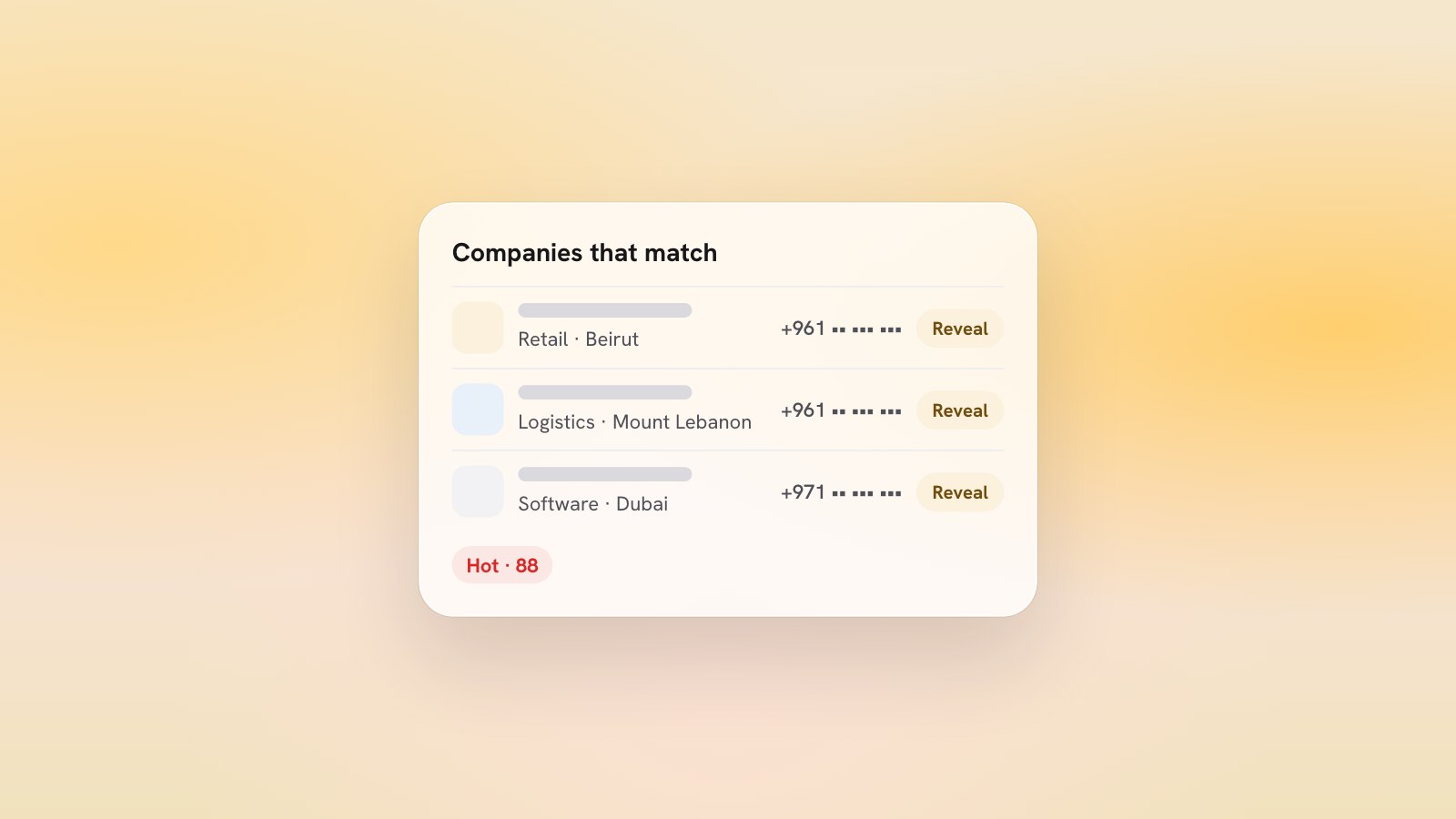
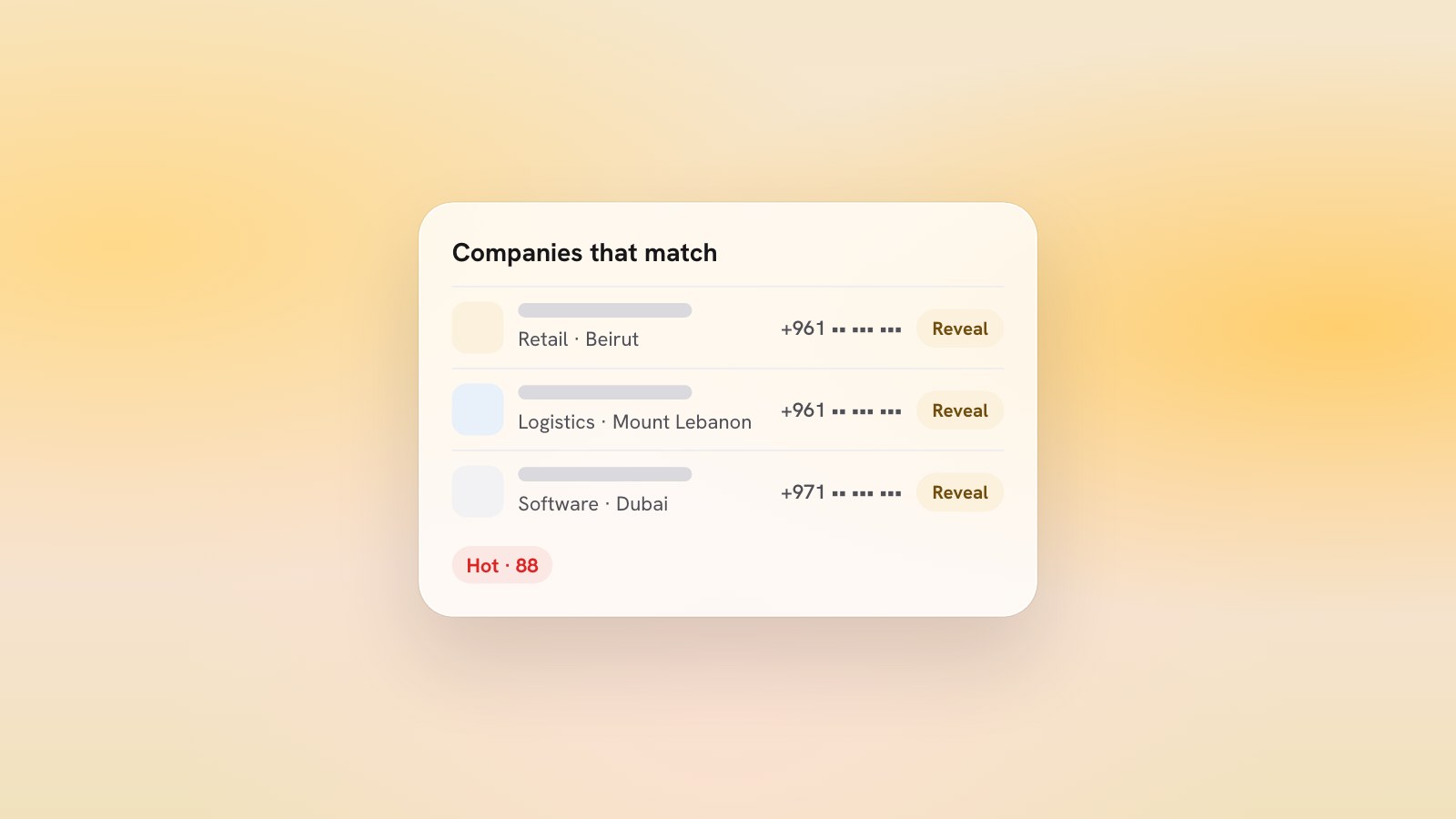
That is the gap LeadsMind fills. It builds company records from Google Maps listings and company websites, adds decision-makers from public business profiles such as LinkedIn, and scores every company against your ideal customer from 0 to 100. Search is free; contact details stay hidden until you reveal a company or a person with a credit from your monthly allowance, and the database is strongest in Lebanon, where you can filter it by sector and city. See how the B2B leads database works.
FAQ
Is there a free list of all companies in Lebanon?
No single free list is complete or current. Google Maps, sector directories and professional bodies are the practical starting points, and each fills gaps the others leave. The commercial register can confirm that a particular company exists, but its terms do not allow its content to be reused for commercial purposes.
How many companies should a first prospect list have?
As many as your team can contact properly in a week or two. A short, well-researched list beats a long one nobody finishes, and it tells you sooner whether your message works.
Can I message a company on WhatsApp straight from its listing?
Not without permission. Meta's policy requires that people have given you their number and agreed to receive your messages, so call first and ask, or invite them to message you.
Which cities should I cover first?
Start where your team can visit and follow up in person, which for most Beirut-based teams means Beirut and Mount Lebanon. Add the North, the South and the Bekaa once your message and your offer are working.
To see which companies in your sector LeadsMind would suggest, type your website at leadsmind.ai/start.