How to Get Leads Without Paid Ads Using a Prospecting Database
Paid ads are not the only way to fill a pipeline. Here is a practical, ad-free approach: build a target list from a company database, score it, and follow up on WhatsApp.
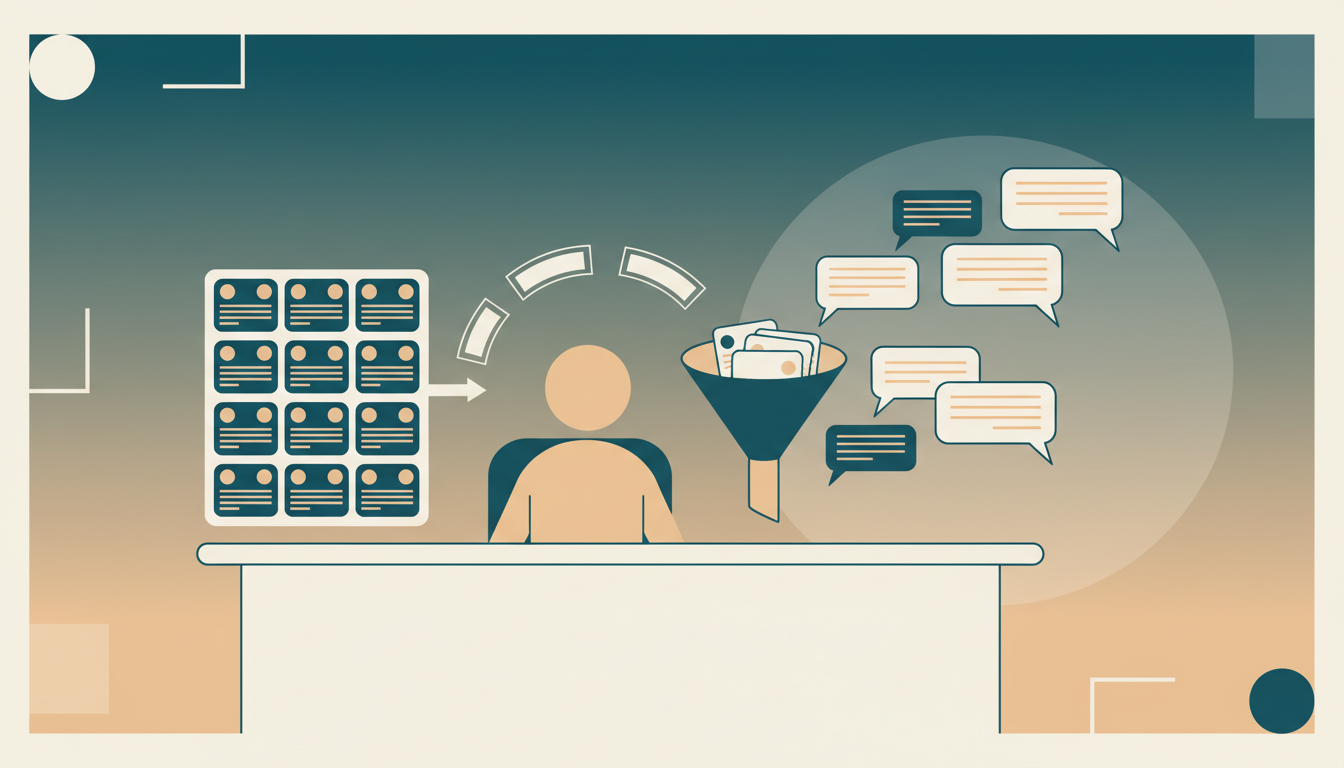
Most small and mid-sized businesses in Lebanon and the Gulf have tried paid ads at least once. Some get results. Many spend money for a few weeks, get a trickle of enquiries, and stop. Ads are not wrong, but they are rented attention: the moment you stop paying, the leads stop too.
There is a quieter, cheaper way that most sales teams still overlook: working from a database of real companies and decision-makers, and reaching out directly. This article walks through how that works in practice.
Start with who actually buys from you
Before you search for a single contact, write down your ideal customer profile. Not a vague description — specifics. A catering company in Beirut might say: hotels and event venues with 50+ staff, in Greater Beirut, with an F&B manager listed publicly.
Answer three questions:
- Who: industry, company size, location, job titles of the people who sign or influence the purchase.
- Why: what problem you solve that they would pay to fix this quarter, not someday.
- When: what triggers the purchase — an expansion, a new branch, a season, a contract renewal.
If you cannot fill these in, interview two or three existing customers. Ask what was happening in their business when they first contacted you. Their answers become your search criteria.
Build a list from a database, not from guesswork
Once you know who you are looking for, the old method was scraping LinkedIn for hours or buying a stale Excel sheet from a friend of a friend. The better method is a searchable database. A tool like LeadsMind lets you search thousands of Lebanese and Gulf companies, filter by industry, size and location, and pull the names of the decision-makers you actually need.
A practical routine: one afternoon a week, one person searches, filters and adds 50 to 100 matching companies to a saved list. That is it. You now have a pipeline of real prospects instead of hoping the right people see an ad.
Two tips that save headaches later:
- Keep lists separate by campaign or segment (for example, "Beirut clinics – Q1" and "Riyadh distributors – Q1"). Mixing everything into one list makes follow-up messy.
- Record where each lead came from. When something works, you want to know what to repeat.
Score the list so you call the right people first
A list of 500 companies is useless if you treat them all the same. Score each lead against your ideal customer profile. Say you use a simple 10-point scale: 2 points for matching industry, 2 for size, 2 for location, 2 for the right job title found, 2 for an obvious trigger (new branch, hiring for a relevant role, upcoming season).
Now the top scorers get a phone call or a WhatsApp message this week. The rest wait. This single habit — working in order of fit rather than alphabetically — is where most of the time savings comes from.
If you use a CRM, the scoring can happen as you build the list, so the ranking is already there when you start outreach.
Reach out on the channel people actually answer
In Lebanon and the Gulf, that channel is usually WhatsApp, with the phone close behind. Email works in some sectors, but a short voice note or a clear WhatsApp message to a named person gets read far more often than a formal letter that lands in an inbox nobody checks.
What works in a first message:
- Use their name and their company. Generic blasts get ignored or blocked.
- One sentence on why you are contacting them specifically.
- One sentence on the outcome, not the features.
- A low-friction question that is easy to answer.
Keep it under about 60 words. Here is a template you can adapt:
Hi [Name], I'm [Your name] from [Company]. We help [type of business, e.g. hotels in Jeddah] with [outcome, e.g. cutting food waste in the kitchen]. Working with [a similar business type, not a name] we've seen [brief result]. Would it make sense to have a quick call this week?If there is no reply, follow up once after two or three days with something short — "Any thoughts, [Name]? Happy to send a one-page summary instead." One or two polite follow-ups is fine; a daily barrage gets you blocked.
Keep the pipeline moving
Outreach without a system collapses in week three. You need somewhere to track every conversation: who was contacted, who replied, who asked for a quote, who said "call me after Ramadan".
Set up a simple pipeline with stages such as Contacted, Replied, Meeting booked, Proposal sent, Won, Lost. Every conversation moves a card forward or marks it lost. A weekly 30-minute review asks one question: what does each open deal need next, and from whom?
This is where a CRM earns its keep. LeadsMind, for example, keeps the database, the scored lists, the pipeline and the WhatsApp history in one place, so nothing depends on one person's memory or a wall of sticky notes.
A realistic weekly rhythm
For a small team, a workable ad-free routine looks like this:
- Monday, one hour: build or refresh a prospect list in the database.
- Tuesday to Thursday, one hour a day: send 15–20 first messages and make follow-up calls.
- Daily, 15 minutes: log replies and move pipeline stages.
- Friday, 30 minutes: review the week. Which segment replied most? Send more of that.
Say that adds up to 60 first messages a week. Even if only one in ten replies, that is six real conversations weekly — from a list you own, with no ad budget and no algorithm deciding who sees you.
Conclusion
Leads without ads come from three habits: a clear ideal customer profile, a scored list built from a real database, and disciplined follow-up on WhatsApp and the phone. None of it is glamorous, and all of it compounds — the list you build this quarter keeps working next year.
If you want to see the routine above running on real Lebanese and Gulf company data, book a demo on LeadsMind and we will show you how your team would use it week one.